








Why Go?
5. The first person to survive the Falls in a barrel was a 63 year old female teacher.
4. Niagara is the world’s second-largest waterfall.
3. Niagara is often listed as one of the Natural Wonders of the World
2. Nearly 20% of the world’s fresh water flows over the Falls.
1. Pictures don’t cut it – seeing it in person is pretty bad-ass.

American Side:
Close Encounters
From Terrapin Point on Goat Island, you can get within feet of the Falls.

Rest Your Head
There are plenty of hotels within walking distance of the Falls. Given the current exchange rate, there are more hotels at affordable rate in New York than in Ontario.

Quality Hotel was a block from the Falls & had a view of Ontario
$50/night (plus $30/night for the pup)
Put it in Park
Niagara Falls State Park ($8/vehicle/day) provides easy access to the Rainbow Bridge border crossing, Prospect Point Observation Deck, Cave of the Wind tour of Bridal Veil Falls and the ever popular Maid of the Mist boat tour.

Feed Me
Hope you like Indian food! Every few blocks has an Indian restaurant, yet the only Asian cuisine is at Koi in Seneca Casino.

You Want to go to Canada, eh?
You can walk ($0.50), drive ($3.25) or bike ($0.50) across the Rainbow Bridge into Canada. Crossing time can be a few minutes or a few hours depending on the season. FYI, they typically won’t stamp your passport unless you specifically ask them to!

Canadian Side:
The Northern side of the Falls is far more commercial than its American counter-part; you can find every sort of tourist trap: wax museums, haunted houses, arcades, a butterfly house(?), a water park, and loads of shopping.

Close Encounters
The $12 price tag is well worth a trip to Journey Behind the Falls; tunnels cut under Horseshoe Falls for an up-close-and-personal glimpse of the cascade.

Put it in Park
Table Rock at Queen Anne Park ($15/vehicle/day) is steps from the Falls, the Canadian Visitor’s Center, Journey Behind the Falls and an easy walk to the casinos and a plethora of dining options.

Feed Me
You can find anything imaginable: Thai, Mexican, Chinese, Texas BBQ, American, Italian, Indian, Japanese, you name it! Note: eateries can get busy and rowdy – the drinking age is only 19.

You Say “Mist,” I say “Rain”
Don’t be fooled, “mist” means “you’re going to get soaked”. Raincoat, poncho, umbrella, waterproof housing for your camera – be ready.

Spin Me ‘Round
The view from the Skylon Tower is incredible – of the Falls and of Toronto on a clear day. If you eat a meal at the Rotating Restaurant at the top (a reservation is a good idea), admission to the observation deck is free too! ($10-15 value)

____________
When to go
High season is May-September. During that time expect to spend a lot of time standing in line at all attractions, view points and at the border (crossing can take 1-2 hours).
In the low season, accommodation is much cheaper and there are far fewer tourists. The trade-off, however is sub-freezing temperatures and the closure of some attractions (Maid of the Mist).

Onguiaahra (meaning “the strait”) is the original Iroquoian name for Niagara Falls – it was changed by Jesuit Missionaries in the 1700’s.


For Christmas this year, I opted to forgo my holiday traditions in California and instead stay on the East Coast. Enter a rental car, a mini road-trip with my pup and the Falls.


I’d never been before, but had always wanted to see the legendary deluge.


Dixon was pretty apathetic
When I arrived in Niagara Falls, New York, I was surprised by what I found; casinos, countless hotels, and chain restaurants (TGI Friday and Hard Rock Cafe, I’m looking at you).

And then I looked across the Niagara River into Ontario. Whao. Vegas of the Great White North.


Not only were there numerous casinos, amusement parks and flashy light, but during the winter months there’s also a holiday faire, nightly fireworks and an evening lights show on the Falls.


Beyond the well-placed tourist distractions, was Niagara. As expected, the world’s second-largest waterfall was breathtaking!


I still can’t quite wrap my head around the fact that 150,000 gallons of water cascade over Niagara every second!

I was also completely unaware that Niagara is actually made up of two separate Falls; Bridal Veil Falls (USA) and Horseshoe Falls (Canada), separated by Goat Island.

Bridal Veil on the left, Horseshoe on the right
There’s a bit of rivalry between the New York and Ontario Niagara Falls and while both have stunning views, I have to admit that the Canucks win the battle of “Best Views of the Falls.”

They’ve got tunnels for a view behind the Falls and ariel views from the Skylon Tower.


During the winter the uber popular Maid in the Mist boat tour is on hiatus – and rightfully so, as portions of the Falls often freeze.

While I had expected there to be a fair amount of snow, given the season, Niagara was snow-less. But, it was plenty icy.


Plus, the “mist” from the Falls provided a steady downpour on the Canadian side.

Being a non-traditional Christmas, I had to have an unconventional holiday dinner. Sushi and sake seemed appropriate!

My time at Niagara Falls proved to be an ideal chance to unwind and have a low-key holiday. Not to mention, I got to cross it off my List List!

Mist through the trees at dusk.
Today, January 6th, is the last day of the 12 Days of Christmas – the time between Christmas and Epiphany.


Mt Vernon, the estate of George Washington, takes the 12 Days of Christmas very seriously.

The Mansion at the estate is decorated to the nines for the holidays and all rooms are made-up as they would have been in the late 1700’s; ready to receive Colonial party-people decked out in their finest wigs and over-sized buckle shoes or rib-crushing, corseted dresses and lace bonnets.

The property sees over a million visitors annually, but only a few thousand get to tour the third floor of the Mansion, as its only open to the public from Dec 1 – Jan 6 each year.

No photography inside the Mansion unfortunately.
The third floor is comprised of three guest rooms and the bedroom that Martha Washington moved into after George died in 1799, as the marital bedchamber was closed and sealed after his death (a perk of living in a 10-bedroom mansion I suppose).

The estate, at nearly 50 acres, contains the Mansion, gardens, sprawling farmland, slave quarters, Washington’s tomb, forested areas, a harbor, plus a sparkly new Visitor’s Center with several museums and numerous theaters.


While packed with information and exhibits spanning Washington’s life (including his wooden teeth!), I found the museum to be rather overwhelming; large-scale dioramas, video presentations, flashing lights, narrations and sound effects reminded me somewhat of a Japanese anime cartoon.


The outdoor exhibits were far less seizure-inducing. On special display during the holiday season were Liberty (the turkey that Obama pardoned around Thanksgiving) and George’s camel (?).

Apparently, good ol’ Georgey had a thing for exotic animals and in 1787 paid 18 shillings to have a camel on the grounds for the 12 Days of Christmas. Whatever floats your boat I guess.

Aside from leaving with a renewed sense of holiday cheer, my visit to Mt Vernon rekindled an innate feeling of patriotism and ultimately a new-found respect for the man at the root of the USofA.

*For more Photo Friday, Delicious Baby is the spot!
Aside from being the largest dedicated forest area in Puerto Rico, El Yunque National Forest’s claim to fame is that it is the only rainforest within the US National Forest System.

View from El Yokahu Tower

Located between San Juan and Fajardo, El Yunque makes an ideal day trip.

Considering the dire financial situation of the Forest System, I fully expected the facilities to be antiquated or at least a bit run-down.


Boy, was I wrong! The towering Visitor’s Center was spotless and appeared to be only a few years old.


Throughout the rainforest, well-maintained hiking trails made it a breeze to get around.


To be honest, El Yunque was better cared for than many National Parks in the continental US.

Not to mention, it was stunning and we nearly had the entire forest to ourselves.

2011 has been a FABULOUS year! As in, maybe one of my favorite years ever. And the craziest part about that statement is that I only left the country once, when I spent a total of seven hours in Canada just last week.

How can that be!?! Here’s how:
1. I moved to a great new city
2. I traveled extensively domestically (20 US states/territories)
3. I got to start over
*******
In February, I loaded up a minivan and relocated to Washington, DC from California via a nine state roadtrip with one of my best gals from college.

2010, though full of international travel, was a really rough year. So when 2011 rolled around, I saw it as a mulligan for my entire life, and DC was at the center of that.
I immediately fell in love with the city; its vibe, arts, people (not to mention its thriving brunch and happy hour culture).

I moved into an apartment and neighborhood that I adore and that feel more like home than anywhere has in a long time.

I found a stellar group of DC-based travelers/bloggers for monthly DCTravelTweetups, joined a group of 15 scholarly ladies in what is probably the best book-club in the entire US and became Co-VP of Events for the Social Media Club of DC.
Between museums, embassies, concerts, protests, rallys and gallery events, there was never a shortage of things to do.

I got to listen to the Dalai Lama speak in July, spent Easter morning at Arlington Cemetery, stood outside the White House the night Osama bin Laden was killed, “survived” Hurricane Irene and the DC earthquake and feel as though I’ve discovered how to thrive in a city that I become more enamored with on a daily basis.

And DC has been a great launching point for heaps of domestic travel. 2011 included trips to:
– Los Angeles, CA – Crossville, TN – Chicago, IL
– San Diego, CA – Oklahoma City, OK – Milwaukee, WI
– Lake Tahoe, NV – Williamsburg, VA – Madison, WI
– Lake Havasu, AZ – Ocean Beach, MD – OshKosh, WI
– Gallop, NM – New York City – Fajardo, Puerto Rico
– Amarillo, TX – Boston, MA – Sacramento, CA
– Little Rock, AR – Outer Banks, NC – York, PA
– Nashville, TN – Wilmington, NC – Buffalo, NY
– Memphis, TN – Myrtle Beach, SC – Niagara Falls, NY
– Portland, OR – Richmond, VA – Annapolis, MD
– Santa Cruz, CA
PLUS, I went to Niagara Falls, Ontario for my very first visit to Canada!
2011 meant saying goodbye to my maternal Grandmother, but saying hello to my adorable Goddaughter, Hannah.

In the process of moving and traveling within the US, I’ve been able to cross a few things of my Life List too:
– Get a tattoo in honor of Bridget and Hayden (May 2011)

– Sing on Stage (live-band karaoke, July 2011)
– Visit Niagara Falls (Dec 2011)

– Spend Christmas abroad (kindof – Canada, Dec 2011)
– See the Grand Canyon (Feb 2011)

– Max out my IRA (year 2 of a 5yr goal)
– Visit all 50 states – knocked out 5 more new ones, plus Puerto Rico.
– Live in a big city (DC baby!)

While my passport might only have been needed once, I still had a stellar year and look forward to what 2012 has in-store!

Cheers!
Happy Holidays from fliplopcaravan!

Currently celebrating the season at Niagara Falls.

Cheers, tidings and goodwill to all!
For some reason, when I left for Puerto Rico, I had in my head that I would see a myriad of tropical birds gliding from tree to tree. I was waaaay off base. Aside from the occasional stray sea gull, the only birds I saw the entire time I was on the island were those caged by the resort.

However, there were enough other critters roaming around that I wasn’t too disappointed.

Centipedes

Tiny Snails

Giant Snails in the Jungle – this one was about the circumference of a baseball

Tiny Hermit Crabs on the Beach

Coqui – Local Tree Frogs (that sound like birds)

Iguanas near the Beach

Iguanas in the Trees
I loved walking around the resort and stumbling upon new wildlife. But, there was one creature that I NEVER actual saw, but was left thinking about far after I returned home…the mosquitos.

I came home with 83 little souvenirs in the form of bites. But if that’s the price for nearly a week in the Caribbean, I’d say I still came out ahead.
For more Photo Friday, head to Delicious Baby!
When I found out that I was going to be sent to Puerto Rico to work a conference for my day job, I was giddy. It was the first time that travel had intersected with my job in a major way and just the thought of packing made me excited.

And then I actually thought about it some more…this was for work, meaning that the attached price tag would not be my responsibility and that the accommodation selected would probably be much different than what I would normally select for myself.

So color me tickled when I found out that I would be staying at the gargantuan and gorgeous Waldorf Astoria property, El Conquistador Resort, in the coastal town of Fajardo.

A resort? Me? The girl who has slept in countless airports, parks and waterfronts to avoid forking over the cash for another night of accommodation? Yeah, that girl.

As expected, the grounds of the Resort were immaculate.

The entire property backed to a 300-foot cliff that can only be navigated by a funicular cable car. (Which was great in theory – until it broke down and stranded about 50 of us at the base of cliff.)


El Con had everything imaginable for a Resort; water parks, a casino, pools, golf courses, night clubs, restaurants, a mammoth conference and events center.

And then there was the private island, Palamino. A private island? Seriously?

A place created to cater to the every whim of a tourist on a beach vacation – snorkeling, scuba, wind surfing, horseback riding, hiking, jet-skiing.

A place where cash is not currency and only your room card allows you access.

I had to hike around to the back-side of Palamino just to find a place that wasn’t inundated with people. Beautiful? Yes. But not exactly a place for relaxing in solitude.

My room was comfortable, well manicured and a far nicer place than I usually lay my head while traveling. That being said, it felt a bit sterile and lacked any sort of personality.

But let’s be honest, I didn’t spend much time in the room anyways. How could I when there was an infinity pool calling my name?

And with the Golden Door Spa just down the path from my room?

And with hundreds of acres of lush property to explore?

Breadfruit Tree
Staying at El Conquistador was a complete novelty for me; a new experience in travel.

And while I can see why it would appeal to many people, I ultimately grew tiresome of the meticulously crafted, “perfect vacation” environment that was being served up with a Mai Thai chaser.

For me, what lay beyond the Resort (“off campus” as the real town of Fajardo was referred to), was far more interesting.
Arguably, the most unpleasant part of any trip is the whole “going home” part. The travel time seems longer, the luggage heavier and the Welcome Home to do list more daunting.

Personally, I have a knack for missing flights and sleeping in airports. Sure it results in more time away, but its rarely comfortable and only belabors the journey home; drawing out the inevitable return to reality.

Another airport overnight
BUT, there is one part of going home that I actually love. Certainly a long shower and my own bed are lovely, however, its that first minute when you walk in the door, that I savor.
Before you settle in. Before you unpack. Even before you turn on all the lights. That minute when everything is still, silent and just how you left it.

Of course its all your own stuff, but somehow it seems alien and only vaguely familiar. It always feels for a split second like just maybe you walked into the wrong place. The feeling only lasts a minute, but I adore it.

Maybe its a strange, subconscious, last-ditch effort for one final moment of the unknown. But more-so, I think I relish the notion that home can somehow feel new and fresh and foreign.

It might be but a fleeting mind game, but its the reason I don’t mind heading home; its something to look forward to!
One of the best things about Beijing is the grub.

Steamed Dumplings on the Street
There is quite literally something for everyone; from super cheap, traditional street food to 5-star international cuisine and everything in between.

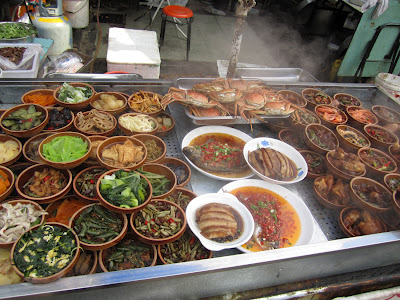
Breakfast: Cucumber & Seaweed Salad, Rice and Tofu Balls
And I mean everything!

Yogurt in Ceramic Jars, Consumed with a Straw

Diet Coke

Veggie Sammy

Fruit on a Stick and Jumbo Cotton Candy

Roasted Chestnuts

Dragon Fruit and Pineapple

Bread, Egg, Tea

Enjoying “colorful” menu options…

Spiced Donkey Meat with Soya Bean Sauce Flavor
Pork Joint with Garlic Sauce

Simmered Chicken with Turtle
Stewed Turtle in Nutritious Sauce

Potstickers

Peking Duck with Plum Sauce

Coffee


Almond Juice

Braised Chicken

Fresh Fruit & Green Tea Ice Cream
Mmmmmmmm!
Situated a mile north of Jingshan Park (on the same north/south axis as the Imperial Palace), the Old Drum Tower was the center of time-keeping in dynasties past.


The highest pavilion of Jingshan Park to the south.
25 drums, known as the Watchman’s Drums, were given a beating every hour, on the hour before such things as watches existed.

The drums are located on the second floor of the tower (a very tall second floor at that) that is open-air, thus allowing the sound to permeate the city.


Today, the tradition continues with hourly demonstrations of the drumming of yore.

The 25 Watchman’s Drums consist of one large drum and 24 smaller drums made of tautly drawn cowhide.

Every aspect of the hourly drumming is ritualized; from the slow, formal entrance procession and initial beats, to the coordinated poundings of militaristic precision.


And every part of the drum is used to create elaborately layered sounds – the cowhide itself, the sharp corner where the hide meets wood and the metal grommets that fasten the hide to the drum’s body.

We were captivated!

Photo courtesy of Conor O’Brien
Old Drum Tower Performance
Just a stone’s throw from the northern Shenwu Gate of the Imperial Palace, lies Jingshan Park.

Originally built when political power moved to Beijing, the artificial hills that make up the park now offer some of the best 360 views of the city.

The White Pagoda of Beihai Park (west)

The Drum Tower in the distance (north)

East Beijing

The Imperial Palace (south)
Though we only caught the basics (due to Chinglish signage), the park apparently is a pivotal component to the Feng Shui of the Imperial Palace.

Five peaks dot the park; each topped with an open-air pavilion.


Providing an escape on weekdays from the hoards of tourists that flood the Imperial Palace, the park itself become a center of recreation for locals on the weekends.

Viewing sunset from the highest pavilion offers a unique (and eerily quiet) overview of the city. Not to mention, perhaps the best view of Beijing pollution, as it alters and blurs the colors of the setting sun.


For muchas mas Photo Friday, Delicious Baby is the spot!
One of my favorite things about living in Washington, DC is that there is always something going on; something new to try. My good friend Bruce (whom I met while living in Denmark) decided to hang out in the District for a long Halloween weekend.

By the time Sunday rolled around, we had gotten our fill of costume parties and were content to watch football all day and grab a drink at one of my favorite watering holes on U Street, Marvin.
As we chatted over a few beverages, we noticed a strange group of people enter and subsequently take over the patio. The group was strange not so much for the fact that they were all dressed like zombies, but because they were all wearing white headphone and dancing in complete silence.

What the?
Turns out we were smack dab in the middle of a Silent Disco pub crawl. Riiight. I still didn’t get it. But being a curious gal, I found one of the event organizers, Matt Khan to figure out what the heck a Silent Disco was.

Matt Khan
For $10 each, Bruce and I were outfitted with our very own pretty, white wireless headphones, that blasted music on two channels – one of which featured a live DJ.

Khan, along with college buddy Mark Owens, founded InkahootZ Presents in 2007 in Charleston, South Carolina before moving the operation to DC. In addition to hosting Silent Discos, InkahootZ also manages local artists and produces charitable events.

Matt Khan & Mark Owens
As latecomers to the party, Bruce and I obviously weren’t dressed in zombie garb, but InkahootZ offered up some free face paint to get us up to speed.


The headphones used are imported from Australia, where Silent Discos have been popular for years. The trend is just starting to gain traction in the US and Khan and Owens hope to expand their operation as interest grows.

For having no idea that such events even existed, I’m now taken with the concept. By nature, Silent Events are localized, often featuring battling DJs and eliminating issues associated with noise curfews.

Additionally, each participant controls their own channel and volume settings – a brilliant feature in my book, as most clubs typically blast music just a little too loud (or maybe I’m just getting old).

Sure, its a bit strange at first, but by the end of the night I found myself disappointed when Khan came around to collect my headset.

The Silent Disco was one of the most unique and fun events I’ve been to in a long time.
And luckily, InkahootZ has setup a solid operation that will have them silently partying all over the District for some time to come.
Check out more information about the Silent Disco movement and InkahootZ Presents.
In honor of All Hallows Eve…Prague is a city known for a bit of mystery. Its an ancient place that (at least for me) drums up images of castles at dusk and dark, narrow, winding alleyways.

Its fitting then, for such a place to have an iconic graveyard.

The Old Jewish Cemetery in the heart of Prague is home to an estimated 100,000 soles.

Which is shocking when you look at the space – for that many people, its not much real estate.


The cemetery was used for over 300 years and when space ran out, a new layer of dirt was added for more bodies to be buried.

That happened 12 times and resulted in an elevated maze of tombstones.

Yet, even though the concept of layer upon layer of bodies is rather ghoulish, the cemetery is actually a quiet and peaceful reprieve from the city.

Happy Halloween blogland!
You’re in Beijing. For the first time.
Excited to see the city and probably to see the Big 5:
– Tiananmen Square & Mao’s Mausoleum
– The Forbidden City (Imperial Palace)
– The Egg
– The Pavilions of Jingshan Park
– Olympic Park


Excited to see the city and probably to see the Big 5:
– Tiananmen Square & Mao’s Mausoleum
– The Forbidden City (Imperial Palace)
– The Egg
– The Pavilions of Jingshan Park
– Olympic Park

The only problem is, everyone else is excited to see those places too.

You decide to spend a day exploring the Forbidden City, home of emperors and political power in China for over 500 years. Sweet!
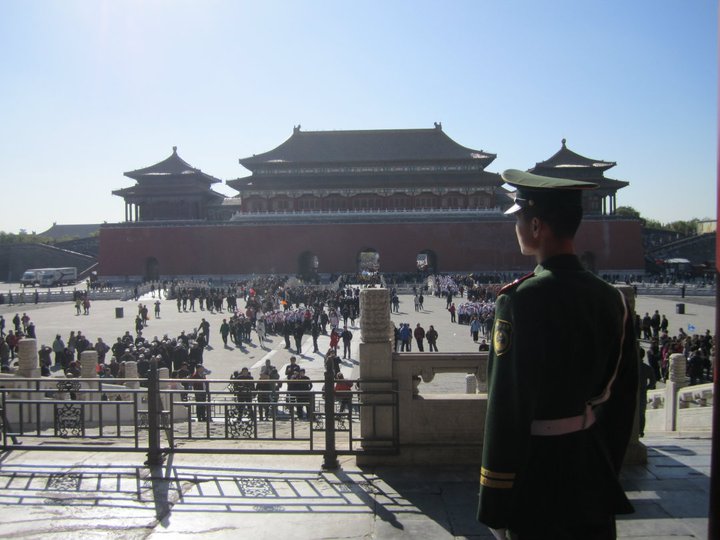
“This place is huge. Sure there are a lot of tourists, but its not that bad,” you tell yourself as you’re herded shoulder to shoulder through the Meridian Gate into the Outer Court.

And there before you stands a stunning display of palatial buildings, halls and terraces. And you get to experience it all – along with hundreds of your nearest and dearest fellow travelers.

Don’t forget to stop at one of the many kiosks to buy some authentic Chinese souvenirs.

Want a closer look inside any of the halls? Say to see the Hall of Supreme Harmony (Tai He Dian)? Or the throne in the Hall of Central Harmony (Zhong He Dian), where the Emperor would rest on his way to attend important events or hold court? Get in line.

And then start throwing elbows, if you actually want a chance to see anything. Or, stand on your tip toes, raise your camera overhead and snap a few shots. Obviously, this is a moment you’ll want to be able to revisit through pictures in the future.

Done with the Outer Court? Head to the Inner Court which was the living quarters for the Emperor and his family.

But be warned – this is just like a Disneyland ride; keep your arms and legs close to your body and hold on tight as you’re moved by the crowd through the Qianqing Gate.

Once in the Inner Court, you can linger close to any number of tour groups to learn something new – just look for 30-50 people wearing matching shirts and/or hats or for someone yelling while holding an umbrella or flag in the air. That’s your tour guide!

Photo courtesy of Conor O’Brien
Want to know why this building (which looks exactly like every other building) is so special? Luckily, there are descriptions outside each one (courtesy of American Express – obviously?).

Assuming you can push enough people out of the way, you might be able to read it.

If you have any energy left, be sure to accept an invitation from one of the pleasant, English speaking “students” who want to show you their artwork. Follow them to the “gallery” and have your pick of anything you’d like to buy. All authentic paintings by “students” – so authentic you’ll see them in shops all over the city.

That should be enough to leave you feeling like an accosted, pushed, hassled, scammed, claustrophobic mess.

Photo courtesy of Conor O’Brien
Man-o-man, this is real Beijing!

And just think, you get to have this exact same experience at every other tourist attraction in the city! Happy Travels!

Or, the Trans-Mongolian route as it were…
1. Get Cultured – Take in a ballet at the Bolshoi in Moscow, a throat singing performance in Mongolia or a Chinese opera. A little too classy for ya? Then sing along to accordion music in a Russian pub, try a hit of snuff with your hosts in the Gobi Desert or show off your dancing skills on a Saturday morning in a Beijing park.

2. Challenge Yourself– Throw yourself into an environment where you don’t know the language, can’t read street signs or a menu and have to navigate through two continents. Sink or swim little fish.

3. Personal Growth– Cheese-ball I know, but see #2. If you can overcome the challenges of this trip, there’s no way you’ll go home without having gleaned some wisdom about yourself.

4. Become a Vodka Shot Pro– You will take many, many shots and you will develop mad skills.

5. Embrace Mother Russia – You might have learned about Russian history at some point in school, but (if you’re like me) you really didn’t learn jack. Russia gets a bad rap, but this journey will be a first-hand re-education about a nation whose actions helped shape the world we live in today. Plus, you’ll get chills just from standing in Red Square.

6. Try New Cuisine – Ever wondered what mutton tastes like? Craved a feast of traditional Peking duck with plum sauce? Wanted to try a Cowberry smoothy? (Ever even heard of Cowberries before?) Expand your mind and your palate.

7. Make Kick-Ass Friends – When you’re on a train for days on end, confined to your sleeping car and the dining car, you will make fast friends. Russians who want practice their English and share their culture (#4 like whoa) and travelers from all over the world who you can commiserate with about how loudly your cabin-mate snores.

8. Enjoy a Slice of Humble Pie – Not everyone has the luxury of gallivanting around the world and traveling. Just the same, not everyone has the luxury of running water or electricity or even their own freedom. Witnessing this first-hand is an education for sure.

9. Find Inner Peace – Or something like that. Ever have that feeling like you’re just a small fish in a big pond? See how you feel when that pond is the expanses of the Gobi Desert. Try a minimalist lifestyle, chant with monks, embrace isolation. Namaste.

10. Try a New Mode of Transportation – Train, bus, hydrofoil, cab, alpine roller coaster, bike, personal driver, ferry, minivan, shuttle, horse, ski lift, camel, tram, subway, rickshaw. Take your pick.

*BONUS – it will be the journey of a lifetime. And that’s reason enough!
The Olympic Park of 2008 that we all watched feverishly obsessively on TV from a distance, was all drama, flare and extravagance. Do you remember the Opening Ceremonies!?!

via bbc.co.uk
So when I ventured out to the Park (via the new subway line that was built specifically for the games) I expected to be dazzled.

While the structures were just as towering and spectacular as I had imagined, I was underwhelmed.


The space felt empty, dead, abandoned. And it was for the most part. There weren’t even the throngs of people that I had come to expect at every tourist attraction in the city.

It seemed like an utter waste. I mean how much money did China invest in building this place?? Four billion? And now it just sits there; a empty space of concrete and steel.

I couldn’t help but feel the lunacy of it. In a nation where millions of people have been displaced by natural disasters and killed by pollution and hundreds of millions more live in poverty, the powers that be chose to throw money at an event to showprove their power and importance.

And now that the show’s over, the problems are still there and the glorious global stage is a metaphorical vacant parking lot.

It is however, a prime spot for kite vendors. So hey, that’s job creation right?

For more Photo Friday goodness, head to Delicious Baby!
Every trip is different. But any given destination remains the same for everyone. Every tourist visiting Rome sees the coliseum; every visitor to Paris, the Eiffel Tower.

So is there really such a thing as a truly unique, original, one-of-a-kind trip?
I thought there was. Part of my desire to travel the Trans-Siberian Railroad was that it very distinctly was NOT Rome or Paris. It was a route less traveled – a destination that still felt raw and unspoiled by tourism. Hell, I didn’t even know of anyone else who had ever done it before.

The first day on the train provided an enthralling, off-to-the-unknown sort-of a feeling. Like central Russia was some kind of uncharted territory. And it was, for me.
But the more people I met, the more travelers I talked to, the more I realized that we were all doing the exact same thing. My “unique” trip was just one of many. Everyone spent a few days in Moscow and saw Red Square, the Kremlin and St. Basil’s. Everyone stopped in Irkutsk and made the pilgrimage to Olkhon Island and stayed in the exact same hostel. Everyone did a multi-day caravan in the Gobi Desert.

What’s more? Every single person I met personally knew someone else who had completed the journey before. By the time the train rolled into Beijing, it felt as though there were few people who hadn’t done the Trans-Siberian.
I’d be lying if I said I wasn’t disappointed. So much for having a wholly original travel idea! Does such a thing even exist anymore? Are there places that haven’t been passed though by thousands of travelers already? Places that Lonely Planet hasn’t boiled down to a basic city map and accommodation suggestions?

I felt deflated, crestfallen. I was still enamored with the trip and the experience, but somehow it had lost a bit of its shine.
It’s not lost on me that the Trans-Siberian is still (comparatively) an exotic and lesser explored destination. And that I went about it in a different way than most travelers; others typically make four stops along the way, Moscow, Irkutsk, Ulaan Baator, and Beijing. I opted to make 11.

In this way, I did have a trip uniquely mine and saw more of the country than those who stayed on the train for days on end. (I probably saw more of the country than most Russians have!)
Not to say that making more stops made the trip any better or worse than staying on-board. In fact, several travelers I encountered were confused about why I would disembark so frequently; “The point is to ride the rails, start to finish. That’s the point of the Trans-Siberian,” they would say.

Same trip, different priorities and expectations. And I guess that’s the real point. We might travel to a place that has been visited hundreds of thousands of times before, but our personal expectations and experiences with that place are what makes it unique – not the place itself.
Now, I look back on the trip with the same enthusiasm I had when I began – although it might not be anything new to the world of travel, it was brand spankin’ new to me!

Photo courtesy of Conor O’Brien
As the world’s largest public square (and a major item on my Life List), we made a b-line to Tiananmen Square as soon as the sun was up on our first full day in Beijing.

The imposing Zhengyang Gate

Chairman Mao’s Mausoleum

Monument to the People’s Hero

Great Hall of People
Everything about the space was larger than life; the buildings, the monuments, the expansive area.

And the largest projections TV screens I’ve ever seen in person.


Not surprisingly there were hoards of people everywhere.

Most were tourists, but there were also scores of “photographers” (I use that word veeery lightly) mulling around, demanding to know if we too would like a photo taken. Um, no.

We were perfectly capable of taking our own photos.

Kelly, Conor, Lara, Denis

Brother and sister
What was far more interesting (and goose-bump inducing), in my opinion, were the cameras not in the hands of the “photographers.”

That’s right, every single light-pole was monitoring our every movement. [We later found out that many “tourists” in and around the Square at any given time were actually plain-clothed government agents.] Talk about feeling watched.

Tiananmen Gate/entrance to the Forbidden City
Naturally, we took it very seriously.

T Square at night
*For more Photo Friday, roll over to Delicious Baby!
After over a month of traveling through Estonia, Finland, Russia and Mongolia, we rolled into Beijing and officially concluded the Trans-Siberian Railroad. A bittersweet moment for sure (it was the conclusion of my DREAM trip after all), but I was eager to explore China!

I’d love to say that I was enamored with Beijing from the moment I stepped off the train, but alas, that was not the case.

First glimpse of the city
Certainly, I expected a lot of pollution (as Beijing is home to almost 5 million cars) and after years of frequenting L.A. I thought I was prepared. But I was shocked. The air was literally thick with pollution and it was only a matter of days before I developed a minor cough.

Right off the bat, Conor and I wanted to book our train tickets to Shanghai in a few days; a task that was much easier said than done. It took nearly an hour of running back and forth all over the station for one customer service desk to another, before we finally located the right window.

Duh. Gotta love Chinglish
Its no secret that cabbies all over the world can be sleazy, money grubbers, particularly when its clear you are a foreigner. But never in my life have I experienced such egregious dishonesty – and from an official taxi stand no less. We were charged 8x what the fare actually should have been! Outrage doesn’t even begin to describe the feeling.

Fuming, we dropped our bags at the hostel and eased our anger with a walk to the south end of Tiananmen Square.

Further consolation was found in the form of curbside veggie dumplings that were so good we nearly forgot about being taken advantage of. (Nearly…)


As I crawled into bed that night (a real bed; a major upgrade from the third class bunk on the 30 hour train ride from Ulaan Baator I had been working with previously) I couldn’t help but smile. I had completed the Trans-Siberian railroad – a life goal, achieved. And, there was so much more travel ahead!

Every border in the world has its own style, vibe and quirks. Some are painless and the authorities greet you with such apathy that you question whether or not they’ve processed your paperwork at all. Others seem to be in sadistic competition for “World’s Most Tedious/Annoying/Confusing/Sketchy/Slow Border Crossing.”Considering that China requires entry Visas, I guessed that the border experience would lean towards the latter.

After hours barreling through the empty expenses of the Mongolian countryside we made it the border. It was nearly 11pm when the Mongolian officials boarded the train, collected our passports and disappeared. (Sidenote: I hate when border agents take my passport out of view – turns my stomach in knots!)

When they finally nonchalantly reappeared, over an hour had passed. After they disembarked, the train lunged forward a bit more, stopped and then took a sharp left turn into a warehouse. What the?

The doors at each end of the car were locked. Curious, we looked out the window and saw several men meandering around in hardhats. Then, the entire train jolted up. As in, into the air. On a giant jack.

What was happening? Well, as it were, China (in its decades-long quest to safeguard itself from outsiders) decided to buck trend and create its own rail system with tracks of a different width than any other country in the world.

Basically, they made it impossible for foreign train to just roll into the country. We were jacked up in the air, so that the meandering workers could swap out the existing train rails in favor of the noticeably narrower Chinese ones.

Photo courtesy of Conor O’Brien
The process can take anywhere from three to eight hours. And, in the mean-time all passengers are sequestered on the train and bathrooms are off limits.

Photo courtesy of Conor O’Brien
Rails switched (only three hours later), we were lowered to the ground and met by a string of border officials. They collected, processed, returned, and rechecked our passports and customs forms before searching our bags. The process felt more like an interrogation than any other border I’d been through especially given the late hour.

It happened to be Halloween night, but in hindsight I’m glad we hadn’t celebrated with costumes and libations – I don’t think they would have gotten it and it would have drawn a lot of attention.
After over five hours, we got moving again, bound for Beijing. Verdict: the Mongolia – China crossing wasn’t the worst, but certainly raked up points in the categories of confusion and slowness.

For more Photo Friday glory, hop over to Delicious Baby!
The day before the 9/11 tenth anniversary I walked over the Potomac River on the 14th Street Bridge to the Pentagon.

I was surprised to find the bridge lined with American flags, each labeled with the name of one of the 184 victims at the Pentagon.

While preparations for the Anniversary were well underway, the Memorial was still open to the public.

Just beyond the Memorial’s entrance is a line marking the direct flight path that American flight 77 took into the building.

In the Memorial park, each victim is remembered by an engraved granite and steel bench that hovers over a pool of water.


Benches facing the Pentagon indicate that the victim was one of the 59 passengers on American flight 77, while the remaining 125 benches facing away from the building indicate victims killed inside the Pentagon.


Each row of benches coordinates to the victims’ year of birth as does the bench position in the park.

Many benches were decorated with flowers, notes and personal items.


An unexpected feature of the park was a free audio tour available by calling a local number (202-741-1004 if you’re interested in listening) that explained the park layout and events of day, interspersed with interviews of survivors.

On the morning of 9/11/2001, I was a junior in high school in Sacramento, California. While the gravity of that day was apparent, being on the opposite coast provided a certain amount of detachment.

In DC yesterday, it seemed that everyone in the city was reliving their first-hand experiences from that morning. Recalling evacuations, panic, relief efforts, school closures and effected friends and family.

Via cnn.com
Oodles of noodles, mutton, pickled veggies, current jam, dry biscuits, hot dog doughnuts, fried eggs, rice, soup, Mac Cereal, sweet bread and Mongolian BBQ. Wash down with current tea or milk tea and repeat.


*More Photo Friday glory at Delicious Baby!
Man oh man, do I wish I knew these Gobi hacks before I ventured into the desert. Life on the steppe is much different than, well, most everywhere else. It’s a place where you can go hundreds of miles without seeing another human and a place that can be unforgiving to the ill-prepared.
Learn from my trial and error to ease into life in the Gobi.

Check you vanity at the door – You’ll need to alter your standards of sanitation and personal hygiene. Bring a mirror if you must (they’re a rare commodity), but you may not actually want to look at yourself after a few days. You will stink and look like crap.

Mentally prepare yourself for a complete lack of modern amenities – There will be no electricity. There will be no plumbing or Western toilets. You will have to go to the bathroom outside (squat toilets or out in the open baby!), sometimes in front of others. Wrap your head around all that and get over it before you leave or it will be a long, uncomfortable trip. (Bring: deodorant and baby wipes – just as good as a shower, right?)

Keep your feet warm in the van- When driving around the steppe in between Ger stops, prop your feet up on your bag to help keep them warm. The metal van will literally freeze overnight and placing your feet directly on the floor is the equivalent of standing barefoot on an iceberg.
Don’t leave water bottles in the van overnight! – See above. They will turn into blocks of ice and be completely useless.

Bring a metal water bottle– At night, fill that sucker up, place it on the hearth until hot, then stuff it into a spare sock and throw it into the bottom of your sleeping bag. Ta-da, instant foot warmer (at least for the first hour or two anyways).

Pack candles & lighters/matches & flashlights– These probably won’t be provided and you’ll be in utter darkness in the evenings without them. Also bring extra batteries for your flashlight…there is nothing worse than stumping around in the freezing darkness trying to find the outhouse.

Don’t freak out if you hear sounds in the night – Its probably just the sheep.

Be proactive and collect firewood (re: dried dung) – Preferably before it gets dark. Before going to bed, draw straws with your Ger-mates to see who is on fire-duty for the evening. This person has the responsibility of keeping the hearth glowing for as long as possible – it is a lonely, miserable, yet essential job.

Create space– Living in close quarters can make getting dressed a challenge. Sure, you can ask people to stand outside while you change, but sometimes the extreme weather makes that cruel and unusual punishment. Instead, hang a blanket or sleeping bag from the Ger rafters and make a private dressing room.

Bring paper and pens– Group games help to pass the time. You can also try to write or journal, but honestly the ride is so bumpy that you’ll just end up with a page full of scribbles.

Learn to love milk tea– You will be drinking a lot of it! You may never actually love the taste, but just tell yourself it’s a latte – mind over matter.

In light of Hurricane Irene battering the Eastern seaboard over the weekend, I was reminded of a recent trip to the Outer Banks of North Carolina.

Irene slams a pier of the Outer Banks, NC via TIME

The same pier in calm water in May 2011
Visiting the Outer Banks during the off season, I found the coastal community to be rather charming.

Sure, like most popular beach communities, the main thoroughfare was lined with souvenir shops and kitschy restaurants, but the general lack of people made those things irrelevant.

I also saw something I had never seen anywhere else in the United States…a drive through liquor store! Whaaat? Part of me was infatuated with the concept while another part wondered what the island’s drunk driving rate was.

The beach was nearly deserted during my stay, which made for relaxing evening walks and morning runs.

The pier in the distance


Evening fishing


Seeing the shoreline so empty, I could only imagine how chaotic the summer high-season must be.

*Although there was much hype and anticipation regarding Irene in the DC area, the storm passed without leaving much damage. I never lost power and aside from some high winds, constant rain and downed tree limbs, Irene seemed to pass like any other storm. Best wishes to everyone who was effected by Irene.
The last day of our caravan was spent alomst entirely in the van. By the time we reached our camp for the evening, the sun was already low in the sky and we felt like caged animals. A hike was absolutely vital!

Up into the hills we went. The hike was nearly silent, save for our huffing and puffing, as we focused on stretching our legs.

Donning our Gobi’s warmest, by the time we crested the hill we were dripping sweat and our legs ached.

Photo courtesy of Jacqueline Simone Winston-Silk
But the view quickly took hold of our attention.

It was a sea of golden brown laced through by a glistening river and there wasn’t another sole or Ger in sight.

We’d gotten used to the isolation of the Gobi, but rarely had we seen the desolate landscape from above.

Back down at camp, we played with the resident dogs and goat before dinner.


And dinner that night was a feast! Our hosts prepared a traditional Mongolian Horhag BBQ for us. We were excited, but couldn’t help but wonder, “What the hell is Horhag!?!”

Turns out, its mutton (more mutton? really?). But, its prepared on the hearth by layering meat on the bone, red-hot stones and vegetables (yay veggies!)

I’ll admit I was a bit crestfallen (aside from the veggies). We’d had mutton for lunch and dinner for the past week straight and simply looking at the slabs of meat made my stomach turn (mind you, I put vegetarianism on hold for this trip).

But a girl’s gotta eat, so I had a few bites. And immediately felt ill. I had reached my meat threshold.

Our driver Jackie showed the boys how Men properly eat the meat clean from the bone. For a little man, he packed away an impressive amount of mutton!

Although the guys did their best, they were put shame by the petite Mongolian.

By the time we rolled into bed, everyone was stuffed silly, tired and so ready to get back to Ulaan Baator the next afternoon for a shower!

*Want more Photo Friday? Its at Delicious Baby!
Located on the outskirts of Kharhorin, Mongolia, Erdene Zuu was once the center of Buddhism in Mongolia; from 1596-the early 1940’s the Monastery housed the highest ranking monks and supported the religion throughout the country.


When the Communist Persecution swept Mongolia in the 1940’s, Erdene Zuu was left in ruins as monks fled for their lives and nearly all the temples were destroyed. The reconstruction and restoration efforts are still underway.

Photo courtesy of Jacqueline Simone Winston-Silk

Today, as a UNESCO World Heritage Site, the Monastery is regaining some of its former glory.

The main Tsogchin Temple and the Western Praying Temple showcase salvaged artifacts from before the Persecution as well as new relics. The juxtaposition is meant to symbolize that a bright future is possible from a dark past.

The temples are colorful and intricately decorated. Visually, its nearly overwhelming compared to the surrounding barren landscape.

Photo courtesy of Conor O’Brien

Photo courtesy of Conor O’Brien


More than anything, Erdene Zuu stands as a testament to the resilience of the Mongolian people.

*For more fab Photo Friday, head to Delicious Baby!
Everything you never knew you wanted to know about traditional Mongolian music.
Wooden Flute (limbe)
Made from hollowed-out and sanded tree branches, the sound of the flute is meant to mimic the tones of waterfalls.
Made from hollowed-out and sanded tree branches, the sound of the flute is meant to mimic the tones of waterfalls.

Horse-Head Fiddle (morin khuur)
Used in nearly every type of traditional performance, the horse-head fiddle resides at the core of Mongolia’s culture and national identity. Each fiddle has two braided strings made from hundreds of strands of horse tail hair; one represents male energy and the other female. It’s considered a symbol of Mongolia.

Lap Harp (yatga)
The harp was an instrument traditionally tied to status and was only played in monasteries. It’s 12 strings represent the orders within monasterial hierarchy.

Throat Singing (khoomkij)
The sound emitted in throat singing is actually made by producing two tones at once. Only one performer sing at a time, but their voice is often accompanied by an instrument. Throat singing was an essential tool in preserving oral histories, as the songs and poems depicted not only daily life and nature, but great warriors and battles as well.

While Americans have the saying, “hands are the best tools,” Mongolians have the saying, “throats are the best instruments.”
_________
During an overnight stay near the Kharhorin Monastery, we were treated to a performance by the adorable Shuieen Aylguu. (Seriously, look at him!)

He had perfected his craft over decades and made a living performing and selling his music. And you know we came home with one his CDs (autographed no less!)

While the tones produced by each instrument differed greatly, there was one massive similarity – they were all hypnotic and relaxing.

We sat transfixed by the music, that is, almost transfixed. We were joined by an older solo-traveler (maybe mid-60’s) who clearly was not too big on personal hygiene. Let’s just say his presence was a slight olfactory distraction.

However, it wasn’t difficult to gather that the music was a direct reflection of Mongolian life; everything was in harmony, calm, slow and melodic.

Certainly, throat singing is a acquired taste, but knowing the skill and control needed to produce the bi-tonal melodies commanded our attention and respect.
*Some photos contributed by Conor O’Brien
Once we arrived at our Ger, we had to wait about an hour for our host family to return from getting supplies.

After brief introductions, we were whisked outside and thrown onto horses; sundown was approaching and our hosts wanted us to get a ride in before it got too dark.

I’m not sure I’d call Mongolian horses real horses. They were very short and stout and would fall more into the Pony Category in my opinion. These horses though, had incredibly long tails that brushed the ground behind their rear hooves (I’d never seen tails so long!).

We received fair warning from our guide Deegii – these weren’t your typical riding/show horses! They weren’t domesticated in the least and as such could be very unpredictable and dangerous.

Some members of the group had never ridden a horse before and needed a crash course in How-not-to-get-Bitten-Kicked-Bucked-off-or-Trampled-to-Death. It was a very uplifting and reassuring course for the newbies.

Murtaza was placed atop a black horse that Deegii described as, “crazy and wild and fast.” An interesting choice considering Murtaza had never ridden before.
Of the group, Lara and I were the only ones with extensive riding experience and everyone else seemed quite nervous to be riding wild horses. Frankly, I was nervous too, as it had been year since I took lessons.

I quickly fell back into the swing of things, although I felt like a giant on that tiny horse!

In my head, the horse was named Apricot because he’s an orangey color – very original, I know. We got along swimmingly at first, but Apricot turned out to be a complete ass-hole.

He kept trying to bite and start fights with the other horses. This dude could have been a cast-member on the Jersey Shore given his antics!

Lara’s horse suffered the brunt of Apricots wrath. We physically had to keep them separated so they wouldn’t bite and buck.

“Go” in Mongolian is “Cohcox!” (pronounced ch-ook!) and we yelled it in the deepest most assertive voices we could we could muster.

Lara and I attempted to get a gallop going, but the horses either didn’t have that much pick-up due to their midget status, or (more likely) they were just stubborn little punks.

Riding was a blast although, again, it was freezing. We kept switching the reigns from hand to hand – left hand held on, while the right got some relief in a coat pocket and vice versa.

After that evening ride (and following the camel riding debacle) I determined that my lovely gloves, purchased in Novosibirsk, Russia, were completely useless. You’d think that Russia (of all places) would have the whole “making gloves” thing down. Apparently not.

Not cool Glove Lady!
*Dig Photo Friday? Get some more at Delicious Baby!
**Some Photos contributed by Conor O’Brien and Jacqueline Simone Winston-Silk
Back in Ulaan Baatar, our guide Deegii promised that during our caravan we’d get a glimpse of a “Frozen Waterfall.” Sounded great, but following our experiences with other areas possessing lofty titles, (i.e “The Place with Trees,” that turned out to be low-lying shrubs) we weren’t sure what to expect.

Unloading from the van, we saw an icy stream in the midst of an otherwise flat area; nothing resembling a waterfall in sight.

Our doubts mounted, but Deegii assured us that there was a waterfall just a short walk down the stream.

And man, she wasn’t kidding. The flatland and stream suddenly gave-way to a gapping hole in the Earth.

And there before us was the waterfall, frozen as promised. It was massive and went far beyond what any of us had imagined to be possible.

Look at those little people on the ridge for perspective!
The Gobi is a desert, right?

The chicas – Deegii, Lara, myself and Jacqueline
The waterfall was truly frozen solid – something I’ve never seen before! It was a stunning sight of ice and rock.

We took turns hurling rocksboulders over the side of the 25 meter cliff, thinking that we might break the ice below.

No dice – those boulders did nothing but bounce on the surface without even leaving dents.
Gawking at the waterfall, we were shocked to turn around and see our Ger for the evening off in the distance.

Fifteen minutes of walking through the golden countryside – past yaks and horses – and we found all of our gear already unloaded from the van and deposited in our Ger.

Yaks!

We settled in, looked out our front door and got a view of what our evening had in store…

Following a night of lodging, in an actual town and not in a wayward Ger hundreds of kilometers from anything else, we decided to stock up on supplies before leaving civilization again.

We hit up a pharmacy (there were some tummy/digestive issues within the group that needed to be addressed), a grocery store and an outdoor market.

The market had everything; rolls of linoleum flooring, spare motorbike parts, clothes, toys. It also had an open-air pool hall where we watched children and men battle each other to clear the tables.

I was meandering the stalls when I noticed an old man approaching my brother, Conor. Suddenly, the man was running his hands over Conor’s chest, back, arms and hands. Was inspecting his neck, ears and mouth; all without saying a word.

I was transfixed and highly entertained at Conor’s clear confusion and (polite) discomfort.

Turns out our new friend was a mute medicine man, who routinely examines foreigners for health ailments and then, naturally, expects to be paid for it.

Our guide Deegii came by during the examination and burst out laughing, “You must pay him now. Never let him touch you!” Like a good unknowing foreigner, Conor handed over a few tögrög and we all had a good laugh.

As a reward?/further punishment?/continued cultural immersion? Deegii took us to a vendor selling Airag. A traditional and popular alcoholic beverage, Airag is fermented mares milk.
Personally, I’d read about the libation before getting to Mongolia and was stoked to be able to try it. The others were not so enthusiastic. Especially when they saw how it was served…from large, uncovered, unrefrigerated, plastic vats and then poured into a semi-clean metal bowl.

Obviously the sanitation was questionable at best, but sometimes you just have to look the other way (when in Rome). The Airag didn’t smell awful per say, but it didn’t smell particularly appetizing either.
The taste? Very yeasty. And foamy – almost thick. It didn’t taste anything like milk.

Everyone gave it a try, though tolerances for the drink varied widely. I didn’t think it was horrible, but I’m not sure I could have downed a whole bowl by myself.

After this very enlightening market visit, it was back into the van and back out into the open steppe.
Riding a camel had long been on my Life List, so when we reached the famed Khongor Sand Dunes in southern Mongolia and discovered that we would get ride camels to and on the Dunes, I was elated.

The Dunes themselves were a sight to behold as we drive through the tundra. At over 300 feet tall, we spotted them from miles and miles away.

Even further beyond the Dunes, we could also see the Altai Mountains. The juxtaposition of gray, sky-high mountains, tan sand dunes and brown flatlands was unreal. As Laura described it, “It looks like someone seriously fucked up a movie set! Its like Sahara meets Into Thin Air.”

Regardless, the contrast was stunning.

Unfortunately, the next morning, when we saddled up and rode to the Dunes, was the coldest morning of the entire trip.

A violent and relentless wind thrashed over the steppe and our position, perched atop camels, did anything but offer shelter. The first five minutes were tolerable.

What started for me as a morning of excitement, getting to do something for the first time, quickly turned into a war with my will-power to not cry.

I’d long thought that I suffered from poor circulation as my hands and feet can get abnormally cold at the drop of a hat. Today was a blaring reminder.

As the wind stung our faces and threatened to unseat us from our camels, all I could do was look down at my hands and feet.

Look down to make sure that my feet were still in the stirrups and that my hands were, in fact, still holding the reigns. I couldn’t feel them, so I needed visual confirmation.

Taking photos (which I do compulsively) was torture. The simple act of holding and steadying the camera and depressing the shuttle became a laborious and agonizing struggle.

After what seemed like excruciating hours walking through the brush and over frozen streams, we finally reached the base of the Dunes. (In reality it took about 25 minutes.)

I wish I had been able to enjoy it more.

Had be able to suppress my discomfort and run and down the Dunes. But, I couldn’t. I unsteadily walked a few feet from the seated camels and turned my head away from the wind as best I could.

When we finally re-mounted the camels, I wanted mine to run back to camp as fast as physically possible. However, camels are stubborn beasts and mine preferred to amble at the back of the pack and stop to eat the brush at his discretion. Not being able to exert any force on the reigns, I was at his mercy.

I was little help later when everyone loaded up the van to leave the Ger. Graciously, I was given the “hot seat” in the van – the one seat that felt the heat first and got the warmest throughout the day.

I think everyone thought I was being a drama queen, until they saw how white my hands were and saw the grimace on my face as they started to warm up. It felt like knives stabbing every square centimeter, over and over and over.
It took almost 2.5 hours of holding my hands in front of the heater for me to regain full dexterity.

That morning is my only regret from the trip. Or maybe its just a good reason to go back someday and enjoy the Dunes properly.


*Some photos contributed by Conor O’Brien and Jacqueline Simone-Winston Silk
**For more Photo Friday, Delicious Baby is the place to be!
Sometimes the smallest, most common things – those things we take for granted everyday – can be the most luxurious indulgences when we have to go without. They become special treats to be savored in the moment and cherished in memory.

Such was the case when we stayed in (gasp) a town during our caravan. The town, Arraikheer, might not have had paved roads and we might have still slept in a Ger, but there was electricity and, drumroll please….a shower!

Well, not A shower, but many showers. At a bath-house. That we had the privilege of paying to use. And the icing on that deliciously watery cake? There were hair dryers and flat irons, oh my (for a fee of course)!

I won’t even pretend that that wasn’t the best tögrög I spent in the Gobi. Not to belabor the point, but the shower was a heavenly experience – I felt like a real girl again!

The only downside was that after I was all sparkly and clean, I had to put on the clothes that I’d worn the day before. You win some, you lose some.
And then there was the electricity. In. Our. Ger! Well I never…

With six travelers (two of them serious photogs) all with cameras and iPods that were either dead or running on their last ounces of juice, being able to recharge was necessary and delightful. Sure we had to create a rotation to make sure that everyone got their fair share of low-voltage power, but what a treat.

Had we been a clever bunch (as electricity was not guaranteed) we would have split up the photo taking duties to ensure that at least one camera was functional the entire trip. However, we were all far too giddy to NOT take photos.

Another bonus of electricity? The single lightbulb in the Ger meant that we could actually see by something stronger than candlelight. Oh, to be able to see what you’re attempting to eat or read or write in your journal!

Had there been toilets with plumbing, I might have fainted. As there were not, I was conscious of every moment of the light-filled night.
After a morning of gawking at the glowing Flaming Cliffs, countless hours were spent driving to the South Gobi.

The scenery shifted from rugged red rock to golden flatlands to snow-covered tundra.

The Yol Valley (situated at the base of the Altai Mountains) is home to thriving wildlife during the summer months, making it one of the top attractions in the Gobi.

In the winter however, about the wildlife to be seen are condors flying overhead.

Even though the ground was covered in snow, we decided to have a little hike up into the valley.


The stream that runs through the Yol was (mostly) frozen over, creating a crossing hazard that took us some time to navigate. There was a lot of hesitant leaping and delicate tip-toeing involved.


My boots were not exactly the best choice for traipsing around on snow and ice and I found myself laid-out on my back more than a few times.

Compared to hour after hour in our van/home, being out in the fresh air of the valley was divine. And silent. And shocking not as chilly as we had anticipated.


Things that made me want to globe-trot this month…the goods:

the links:
Madagascar has long been on my “To Go” list; here’s one reason why.
Captivating Moments – Catching Sunset at Avenue de Baobab, Madagascar
– Wild Junket
July has been en fuego and all I want to do is lay-out on one of these icebergs.
Cruising Alaska’s Inside Passage – Velvet Escape
I’m a sucker for good macro shots and these underwater pics blew my mind!
Dominican Republic: Day 4 – My Beautiful Adventure
This was listed as the Most Beautiful Post for the My 7 Links project. No joke.
I got schooled by this post. My childhood education has failed me.
8 Things You Probably Got Wrong About the Great Pyramids in Egypt – foXnoMad
Everything about this post just feels refreshing.
Photos of Brazil – Brendan’s Adventures
I have not been able to get this shot out of my head. Bliss
Travel Photo – Sunset Over Wadi Rum Desert – LandLopers
Such a great interpretation of Once-in-a-Lifetime travels, or rather One of Many.
What happens when your once-in-a-lifetime adventure is over?
– The Fearful Adventurer
the quotes:
Travel quotes heard around DC.
“I cannot wait to be in the Pacific Northwest…I’ll be able to wear microfleece!”
“I’ll be in Istanbul for 10 days next month. Hopefully the cradle of civilization will be cooler than this cauldron of heat.”
“We were in Thailand…finally I had to say to that tuk tuk driver, ‘boy, you had better let me out this thing or we’re gonna have words!'”
“Where were you last birthday?…Oh, Malawi, that’s right.”
“When I came back from six months of traveling and I had exactly $12.00 in my savings account.”
“You have to go to Kenya! A trick we have there…tourists will try to ask for directions using their pocket translators. We just look at them blankly until they finish and then in English say, ‘Okay, so go two blocks and then take a right…'”
I had always had the notion that the Mongolian tundra was a completely flat expanse. As I quickly found out, the terrain is wildly varied and transitioning from snow-capped mountains to flatlands to sand dunes to cliffs in one day was par for the course.

Aptly named, the red rock Flaming Cliffs (also called Bayanzag) appear to be on fire when the sun hits them just so.

Getting there first thing in the morning gave us the benefit of seeing the area in all its glory.

From the top of the cliffs, we could see for miles and miles in every direction.

And what did we see? Absolutely nothing.

Talk about feeling isolated and cosmically insignificant.

Though the cliffs are gorgeous, they aren’t famous solely for their aesthetics; they’re the site of many important paleontological discoveries. In the 1920’s, dinosaur eggs were unearthed here – the first ones ever found anywherein the world!

Such discoveries drew scientists from all over the world and unfortunately left the area stripped of most of its pre-hostoric artifacts and fossils (almost all were taken out of Mongolia by foreign researchers). Just yet another example of a country being robbed of its natural resources for the benefit of the first world.

Photo courtesy of Conor O’Brien
*For more lovely Photo Friday, head to Delicious Baby!
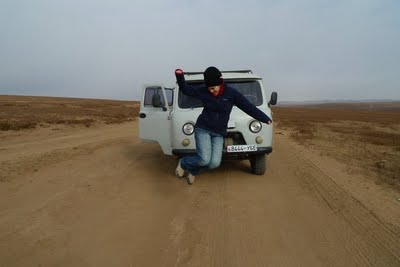
The rugged terrain that comprises the majority of Mongolia is not exactly easy on vehicles.


We experienced three flat tires (one in the dark) and frankly, I was shocked that the number wasn’t higher.

Those who live in the steppe are accustom to constantly repairing vehicles and are pretty much mechanical ninjas. Our driver Jackie was no exception.

After hours of driving and not seeing a single sign of civilization, Jackie spotted an abandoned van and pulled over to see if there were any spare parts he could collect for future use.

Just as we were pulling away, a motorcycle appeared, seemingly from nowhere.

Suddenly, our course changed and we were following the motorcycle in the opposite direction. 10km later, we saw our destination – in the middle of a river.

A truck was stranded in the icy water and had, we learned, been there for over six hours!

A man was barefoot in the river attempting to free the truck with absolutely no progress. We were all horrified that he was IN the river! His feet had turned a deep hue of purple and I got chills just thinking about how cold he must have been.

Jackie produced a rope that was attached to both vehicles and he attempted to pull the truck free. The rope snapped.

As a last ditch effort, the man in the river used his saffron, silk waist scarf as a rope. This was highly unusual because the scarf is seen as a sacred garment – he was THAT desperate!

After a few tries, the truck finally pulled free and made it to shore.

The whole encounter took only 30 minutes. All I could think about though was how long it would have taken if we hadn’t happened to be in the area as the motorcycle came by.


*Some photos contributed by Conor O’Brien & Jacqueline Simone Winston-Silk
During my Gobi caravan, nearly all day, everyday was spent driving in the van – anywhere from 6-11 hours/day.


Evenings in the Ger provided a bit more space, but lacked electricity. Basically, modern entertainment wasn’t an option.

It reminded me of road-trips my family would take when I was a child; before even Gameboys or Disc-men existed. To pass the time we had to get creative.

Passing the Hours in the Van –
Listening to Music (thank god for ipods, at least until the batteries died)

Sharing stories and singing (our guide Deegii had a beautiful voice!)

Playing games – Celebrity Heads (a slightly more difficult game when everyone has varying degrees of exposure to media and different cultural backgrounds)


Napping (the old standard)

Passing the Hours in and around the Ger –
Playing with animals in the area (everything from dogs and cats to goats and horses)


Reading by candlelite (much easier to do in the Ger than in the bumpy van)

Journaling (penny for your thoughts?)

Flying Kites & Playing Frisbee (far more entertaining than we originally thought)


Staying Warm (hiding in sleeping bags and blankets)

Drinking Games (the Irish game Fingers and the Mongolian, This or That were favorites)

Exploring the area around camp

*Some photos contributed by Conor O’Brien, Jacqueline Simone Winston-Silk & Denis Donnelly
7am – Have already been awake for several hours, freezing. Begrudgingly get out of bed, eat breakfast and pack up.


7:30am – Realize that the van has a flat tire. Driver Jackie fixes it like a champ!

7:45am – Get in the van. Its an icebox – as in, the whole thing is frozen. Think, “Ahhh, when will I be warm again!?!” As we drive away, our host family flings a cup of milk at the van for good luck.


10:30am – Stop at a temple to take a break and have a look around. Monk shows us the sacred scrolls of the temple. Think it might actually be warmer outside than in the van.


11:45am – Camel spotting!!!!


1pm – Stop to see a Chinese copper mine.


1:45pm – Lunch! Milk tea, followed by a soup of fatty mutton, rice, onion and celery, all topped with sour cream. Finally feeling warm – I can feel my feet again (minor victory)!


4pm – Pit stop in a tiny town to buy water and snacks. Run into some kids and have an epic dance-off in the middle of a dirt road. They had me doing handstands and the Running Man! Leave a few packets of sour patch kids in their capable hands.


6pm – Arrive at our Ger for the evening, unload the van and enjoy milk tea with the family.

6:30pm – Conor, Denis and Murtaza play Frisbee while Lara, Jacqueline and I check out the nearby hills. The area is known for “having trees,” (!?!) which are really more like tall shrubs. Collect firewood on our way back to the Ger.


7:30pm – Lovely sunset! Conor helps Jackie fix a second flat tire.


8pm – Dinner is rice and mutton with pickled carrots and peppers. It tastes delish (or I’m just that hungry).

8:20pm – Share a bottle of vodka with out hosts, followed by another bottle in our Ger.

10:30pm – Bed time. Pile on the layers and curl up into a ball in my sleeping bag. Pray that its not as cold as last night.

Vajrapani – one of three Buddhist protector deities…
please protect me from the cold!
please protect me from the cold!
For more glorious Photo Friday, Delicious Baby is calling!
Our first evening in a Ger (owned by a lovely couple and their adorable daughter) was something of a live-action “Mongolian Customs for Dummies.”


Who knew there would be so many rules!?!
Rule #1 – Do not stand on the Ger threshold.

Rule #2 – Do not walk or pass anything through the support beams of the Ger (its bad luck). This is a lot harder than it sounds considering space is at a premium to being with, let alone with 6-8 people and all their stuff.

Rule #3 – Wearing hats inside or touching anyone on the head is veeeery disrespectful. (So, the hat thing was really more when socializing indoors because we all wore beanies to bed to try and stay warm)

Rule #4 – Women do almost all of the cooking/cleaning, unless meat needs to be cut, in which case the male head of house is responsible.
Rule #5 – The youngest woman present serves the male head of house his meal first and then serves everyone else before herself.

Rule #6 – She is also responsible for pouring the milk tea and collecting all dishes at the end of the meal.

Rule #7 – After dinner vodka shots are common and again, the youngest woman is in charge of pouring (she’s basically everyone’s whipping boy). It is considered very rude for anyone else to touch the vodka bottle, especially guests!

Rule #8 – All items (shot glasses, plates, etc.) are passed with the right hand while the left hand supports the right elbow. The same is true when accepting any item.

Rule #9 – The male head of house initiates the pace of vodka shots and they typically continue until the bottle is gone (Oi).
Rule #10 – If you don’t want a shot, you still must accept the glass with your right hand, touch your mouth to the rim and then hand it back. (This really only applies to women, because a dude refusing to take a shot is grounds for ridicule by all other men in the room.)

Rule #11 – If a snuff (powdered tobacco) bottle is passed around, always accept with you right hand and cradle the bottle in your palm. Scoop a bit onto the snuff spoon and snort – once in each nostril.

Rule #12 – Not down with snuff? Still accept the bottle, open it, take a whiff and then pass it on (with the right hand of course).

It took us awhile to get comfortable with all of the customs; draining an entire bottle of vodka certainly didn’t help our retention.

That first night, we went to bed full, drunk, warm and happy. It lasted a few hours.

Then the fire burned out, the temperature plummeted and discomfort set in. Conor (bless him!) got out of bed at 4am to try and restart the fire with little success.

It wasn’t until just before 7am that one of our hosts came in, relit the hearth and left a new pile of dung to burn. We all just stared at her from our sleeping bags in awe and appreciation.

Up to that point, night one in the Ger was the coldest night of sleep I’d ever experienced. But that was only night one…

One of my favorite things about traveling is receiving an education about each destination. No matter how much I think I know about a place, I always learn more when I’m there in person.




I didn’t know all that much about Mongolia before venturing out into its vast and unspoiled steppe. And, I knew virtually nothing about the history of Buddhism in the country and the challenges it faced at the hands of Communist rule.

__________
After filling up (and warming up) on homemade noodle soup, our next stop was a snow-dusted rock outcropping several hours drive away.

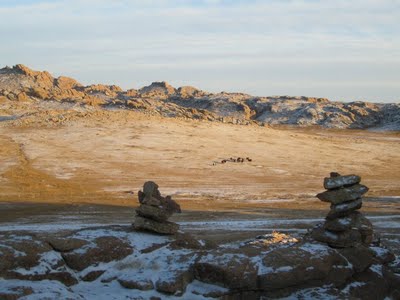
We instantly noticed stacks of rocks everywhere.


Deegii informed us that these stacks designated the area as a sacred place.

In the center of the outcropping was the black mouth of a cave.

Monks sought refuge and shelter there as they hid from soldiers during The Persecution from 1937-1939. Though we were all curious to explore the cave, we refrained as it now plays host to a large snake population.

A short drive away were the ruins of Buddhist temple.


Bright blue, tattered silk scarves floated from the trees.

This temple used to house 300 monks; all but a handful were killed by Communist soldiers.

Under Stalin’s order, The Persecution saw the destruction of over 700 monasteries/temples and 30,000 monks were killed or sent to labor camps in Siberia.

For a quiet, respectful and hospitable people, such violent subjugation struck me as completely unnecessary.

The area had a solemn atmosphere and we found ourselves whispering for no apparent reason. And, as if it weren’t cold enough, the place gave me goose bumps.

Even though the temple marked a place of death and destruction, it remained vibrant; perhaps a silent protest to the oppression seen the there.


*For more fab Photo Friday, skip to Delicious Baby!
Our first day on the road began at 9am as we pulled out of Ulaan Baator and hit the open road. And by “open road” I mean, a very, wide-open, dirt road.

I couldn’t believe that our driver Jackie knew where to go. There were no directional signs of any kind and yet he knew exactly which dirt track to take.

Very soon after getting out of the city we hit an Ovoo (the first of many). An Ovoo is a mount of rocks, often crested with blue silk scarves. These cairns are religious sites used to worship different aspects of the landscape.

When encountering an Ovoo, its customary to circle the pile three times in a clockwise direction and add stones or offerings to the mound to encourage a safe journey.
Our drive that day would cover over 300km, on bumpy, jarring, dirt roads, giving us plenty of time to get to know our guide better.

Deegii was a star student in high school and was even interviewed on the local news for finishing school never having received a test score lower than 93%. She graduated University at age 19 and then joined the army for several years where she became a highly skilled equestrian and archer.

She now works for the National Arts Council and as a tour guide on her free time. I was struck by how fiercely proud she was to be Mongolian and by the fact that even though she had an advanced education, she wanted to remain in Mongolia and help preserve the country’s traditional culture.
After hours in the van, we saw the rounded white top of a Ger in the distance. This was our lunch stop.

Gers in the Gobi function as everything from restaurants to hotels to repair shops. Mongolians are unbelievably hospitable and travelers can stop at any Ger for a rest, a meal or help without question.

Inside the Ger we met our hosts, an older couple with three kids and eight grandkids. They quickly got busy making our lunch.

Meat was chopped off the bones and cubed (by the man of the house).


Sliced potatoes, carrots and spices were sauteed in a giant bowl on the Ger’s central hearth.

The meat was added and cooked until brown.

A ball of dough was rolled into a huge, thick circle, doubled over several times and then cut into strings.


And just like that there were homemade noodles.

The noodles and some broth were added to the bowl and left to simmer.


The interior of the Ger was warm and colorful. A TV perched in the corner ran off a solar panel powered battery pack – a very common practice for nomads.

Mongolian nomads move four times per year, following their herds and the seasons. It takes only about 30 minutes to break down a Ger, but over 2 hours to set it up again.

By the time the soup was ready, we were ravenous! Maybe it was being hungry or being cold, but at the time I couldn’t imagine eating anything other than that delicious soup.

After prepping for the caravan through the Gobi (and dreaming about it) we finally settled on a eight-day route:

Day 1 – Lunch at the Morin Tsohio Ger restaurant and drive to Bagagazariin Chuluu
Day 2 – Bayanzag and the Flaming Cliffs
Day 3 – Hiking in the Yol Valley, head to the Khongor sand dunes
Day 4 – Camel riding at Khongor then drive to Arvaikheer (a “city”)
Day 5 – Orkhon Waterfall and horseback riding
Day 6 – Kharhorin Monastery
Day 7 – Stay the night in the Lun area
Day 8 – Head back to UB

It seemed straightforward enough, although in all honesty, we really had no idea what we were getting into.

One thing became very clear on Day 1, the van was our new, mobile home.

Our caravan was arragned through our hostel, Khongor Guesthouse, as they offered numerous itinerary ideas that were completely customizable. In the end, we decided on a custom eight day caravan that provided us one day to prepare for departure. And boy, did we need it!
Assemble a Travel Group –
Make sure these are people you at least somewhat like – you will be spending every waking minute with them and will be within five feet of them the majority of every, single, day. Don’t pick assholes.
Make sure these are people you at least somewhat like – you will be spending every waking minute with them and will be within five feet of them the majority of every, single, day. Don’t pick assholes.

Typically, the more people you have traveling together, the cheaper it is per person. Ideally, you want to fill every seat in your van (duh). I traveled with six passengers – Conor, Lara, Jacqueline, Denis, Murtaza and myself, plus our driver Jackie and guide Deegii.
We added Murtaza last minute – we met him in the common room at the hostel in an incident that truly puts into perspective what a small world we live in. Murtaza and Lara actually went to high school together in Sydney, Australia and no idea that the other was traveling, let alone in Mongolia and staying at Khongor. Such a random coincidence!

The crew: (left to right) Jackie, Murtaza, Denis, Kelly, Lara, Deegii, Jacqueline, Conor
Be Comfortable with your Driver and Guide –
These folks are essentially in charge of your life during the caravan. Like your travel group, you will be in (very) close proximity to them everyday, so if you have any apprehension, be sure to address it before you leave. Also, don’t piss them off; you want them to like you. We broke the ice with some karaoke the night before we left.

Be a Polite Houseguest & Bring Gifts –
You’ll be staying with a different host family each night of the caravan. They will give up their beds for you, feed you and make sure your ger stays warm, so the least you can do as a thanks is bring them a present.

A much appreciated gift is a bottle of vodka (a people after my own heart) – to be presented to the male head of the household upon departure from their home. Also great to bring are colored pencils and sweets (preferably from you home country) to give to the kids. FYI, sour candies tend to get the most dramatic responses!

Stock up on Snack Food –
You will (most likely) be provided with a small breakfast, plus lunch and dinner each day, however, it can be 6-8 hours in between formal meals. People get cranky when they get hungry and they will be cranky right next to you. Do yourself a favor and bring some snacks.

Prevent Scurvy –
Okay, so you probably won’t get scurvy in a week, but fresh (vs. pickled) fruit and veggies are scarce in the Gobi. Bring your own! After a week of eating (almost exclusively) pasta or rice, mutton and milk tea, I was ravenous for some produce! If you’re a vegetarian or vegan (like myself) you will have to take a break during the caravan or bring all of your own food.

Bring Plenty of Water –
Chances are, your guide will pack a set amount of water per person per day, but its a good idea to bring extra. You’ll be using bottled water for ev-er-y-thing; drinking, brushing your teeth, bathing (if you’re brave), washing your hands. The last thing you want to do is run out.
Pack for the Tundra! –
It will be freezing (FREE-ZING) at night. Like, you-will-wake-up-from-a-dead-sleep-from-being-so-cold freezing. Bring as many layers as you can! I cannot emphasize this enough – thick socks, sweaters, jackets, scarves, gloves, beanies – bring ’em all, you’ll need them.

Sleeping bags will probably be provided, but they’re not always built for sub-zero temperatures (strange for a place that specializes in, well, sub-zero temps). If you have your own, bring it. If not, bring more layers!

Huddled in a sleeping bag, in front of the fire
Get Amped Up! –
Even though it might be a smelly, freezing, bumpy, protein-heavy trek, it will be unforgettably fabulous adventure. Its the Gobi for god-sake!

Once we had all of our gear and goodies packed up and ready to go, all that was left to do was hit the road.

Located on the eastern end of Ulaan Baator, Gandan Monastery is the center of Buddhism in Mongolia.

Made up of over a dozen temples and datsans, Gandan exudes an inexplicable sense of calm.


The morning was frigid as we made our to the Vajradhara Temple for its daily service.


The doorway to the temple was draped with a heavy blanket to keep the crisp air out.

Inside, people filled every corner of the room. Monks chanted methodically while colored ribbons were tied to the top of a wood and glass box. Handfuls of rice rose into the air and fell gently to the floor.

The crowd crushed froward, attempting to grab and drape the ribbons over their shoulders.

After serval minutes of prayer, devotees filed one-by-one past the alter at the front of the room to leave offerings; an orange, a trinket, rice.

Outside, snow began to fall and the wind stung our faces.

Mongolian burka
Pigeons flooded the courtyard and visitors sought refuge from the cold.


We made our way to the imposing Migied Janraisig building – the symbol of Mongolian independence – that houses a four-story golden Buddha.


Prayer columns surrounding the statue were hand-spun for good luck.


The walls were lined with effigies of past llamas; killed during the Persecution from 1937-1939 when communists attempted to eradicate Buddhism in Mongolia.

Monks lingered in open doorways as we left the monastery in search of a cafe for hot tea to warm our numb fingers. Though we only spent a morning at Gandan, we left frozenfeeling placid; centered and clear-minded before heading back into the pulsing center of UB.


Inside Vajradhara Temple
*Some photos contributed by Conor O’Brien and Jacqueline Simone Winston-Silk
**For more lovely Photo Friday finds, head to Delicious Baby
*This post is my entry into the TBEX Blog Carnival Contest sponsored by Choice Hotels International Services Corp (Cambria Suites).
I currently live in Washington, DC, one of the top tourist destinations in the country. So what’s a DC resident to do when they want a weekend away without having to travel very far? I spent a weekend three hours northeast of the capitol city, in Ocean City, Maryland, to find out.You may not need a passport to get there, but be prepared for a foreign experience.
Friday Afternoon/Evening:
Upon arriving in Ocean City (OC), check into your hotel and settle in. The Flamingo Motel is a prime example of average accommodation in OC; its basic, but close to the beach and won’t cost you an arm and a leg.

After unpacking a bit, walk a few blocks south to Mother’s Cantina, the best Mexican food in OC. Its certainly not cheap Mexican, but if you’re craving a giant burrito and a great margarita, Mother’s is the place. Plus, they offer tons of vegetarian options and $1 tacos during happy hour.

Kick back a few ‘ritas and then head to the motel to get dressed up for a night on the town. And by “on the town,” I mean, at Seacrets. Its theOC nightlife destination.

Located on the beach (caution when wearing heels ladies), it features 17 bars, multiple clubs and dance floors, live music, DJs, and excellent people watching. During the day, Seacrets is a family-friendly restaurant, but come nightfall all bets are off and parents should keep their children far away.

Its an alternate universe really, a slice of an MTV Spring Break special. Tawdry? At times. Entertaining? Absolutely. Be ready to get hit on from every direction and dance the night away.

Walking home in the wee hours of the morning may be an ambitious endeavor, so spring for a cab or hop on the OC Bus ($1/ride) that zips up and down the Coastal Highway.
Saturday:
Take it easy and sleep in. When you roll out of bed, walk south to Happy Jacks Pancake House for a quick (assuming there’s not a line) old-diner-style breakfast. Portions and prices are reasonable, but don’t expect exceptional service or ambiance.
With your body replenished, grab a towel and sunblock and make for the beach.

The farther south you go, the more crowded and rambunctious the beach becomes (the heart of the boardwalk is to the south).

Sunbathing, swimming (watch out for rip tides) and people watching can easily fill your afternoon.

When you’ve tanned to contentment, take a stroll along the boardwalk. If you’ve ever had the misfortune to watchseen MTV’s Jersey Shore, the boardwalk might look familiar. Lined with Italian restaurants, suggestively named bars, tattoo parlors and tee shirt shops staffed by eastern european women, you’ll have to remind yourself that you are, in fact, in Maryland.

Snag a cool treat from the roving ice cream trucks (those still exist?) to cool off before heading back to the motel for a quick dip in the pool and a shower.

No doubt the sun will have zapped your energy, so drive across the Harry Kelley bridge to Hooper’s Crab House.

Request deck seating for a sunset view and indulge in the $27.99 All You Can Eat Meal – bottomless steamed crab, shrimp, fried chicken, corn on the cob, and hush puppies.

As you wash it all down with a beer sampler paddle, you’ll marvel at the fact that you’ve been eating for the past 2-3 hours straight.

On your way back, stop at the Jolly Rogeramusement park. There are two locations; one at the southern-most end of the boardwalk and one on Coastal Highway that’s geared towards children and is the more mellow option. Sure, you might be the only adult not accompanying a child, but the view from the ferris wheel is worth it and cotton candy for desert will make you feel like a kid again.

If you’ve got any energy left, ditch the car at the motel and make your way back to the hustle and bustle of the boardwalk at night. Don’t be surprised if people yell at you from high hotel balconies requesting that you join their party and take a beer bong.

Should you be flattered or offended? That’s your call, but regardless, you’ll be entertained by the utter debauchery surrounding you.
When you can no longer stand the insanity, call it a night (or if you’re wide awake, spend another night at Seacrets).
Sunday:
Not to be missed is sunrise on the beach.

Getting up before the masses provides not only a view of the near abandoned sandy expanses but also a chance to discover “leftovers” from the raucous night before; revelers passed out on the beach or in lawn chairs outside their ocean-front hotels

Its ridiculously hilarious at best and somewhat depressing at worst. Whatever your take, its a unique (?) time to view OC.

Grab a coffee at Dunkin’ Donuts (it’ll be about the only coffee shop open that early) and rally the troops to pack up and check out.
Sure, it’ll be bittersweet leaving a gawker’s paradise, but you’ll feel empowered by the fact that there’s more in store for you today than a hangover and regret.

Load up and drive south to Assateague Island. You’re sure to see some of the island’s celebrity residents – the wild ponies – meandering the brush or stopping traffic on the roads.

If you’re feeling sporty, rent bikes or take a hike, but be wary of the swarming/attacking mosquitos – they will literally chase you down.
Otherwise, head to the beach for a bit of R&R. You’ll feel isolated here compared to the beach in OC; no one will hassle you, try to sell you things or accidentally kick sand on you while navigating through the hoards of beach-goers.

Assateague beach is what OC beach must have been like before the influx of cheap motels and intemperance.
On your way back to the real world, grab a late lunch/early dinner at the Globe Cafein Berlin. The quaint town streets and rotating art exhibits inside the Globe will help you transition back to normalcy.

Spend the drive home reminiscing about the weekend. You surely saw/experienced things far outside the realm of everyday life and maybe even made a friend or two on the beach or at Seacrets?
Its much like a weekend in Vegas; a weekend is about long enough. And Secrets should stay there.
Ulaan Baator (UB) is the heart of Mongolia. The most populous city in the country, it simply feels alive. It has an electric quality, as though the whole city is buzzing (or maybe that was just my own excitement).


I was surprised at how modernized the city was. English is spoken almost everywhere and many signs are in English as well. Its a strange juxaposition of old/traditional and new/modern; monks walk side by side with women flaunting designer jackets. Yet, it seems that everyone exists in harmony and is respectful of variations in lifestyle choices.

Traffic –
UB traffic is insane! The streets seem to be continually congested and there appears to be a lack of general traffic laws. Its the first place I’ve ever been where cars literally do not stop for you; everyone runs across the street (even in crosswalks).

Entertainment –
Mongolians like to drink; from Chinggis beer to shot after shot of vodka. Living in close proximity has bred an extremely social culture that has no problem letting loose. (I think the subzero winter temperatures have something to do with it too!)


Karaoke, in private basement rooms, is another Mongolian favorite (and often goes hand-in-hand with drinking).

Our guesthouse was conveniently located across a courtyard from a karaoke club and we spent several nights belting out everything from Proud Mary to Gold Digger while listening to our neighbors sing hits from Mongolian boy band Camerton.

Air Quality –
Is less than desirable. While the city center is modernized, those living on the outskirts of town live a much more traditional lifestyle. People still live in Gers (circular, felt lined dwellings) and burn wood and dung to heat them. As such, the sky is quite cloudy and a thick layer of smoke cloaks parts of the city.

Shopping –
The State Department Store is a UB shopping fixture. Its like a mall (with designer duds, toys, groceries, cosmetics, etc.) but none of the stores have walls, its just one big open space.

The act of shopping there is unlike any shopping experience I’ve ever had! You cannot move items from one department to the next without getting a written note from a sales clerk and paying first – a lesson I learned the hard way.
I wanted to purchase a big, warm, down jacket for the Gobi and also a beanie (located in a different department). As I wandered over to the beanies, with the jacket in hand, I was followed by two saleswomen saying, “Excuse me…excuse me.” About the same time, I noticed that Conor was surrounded by security and sales staff – he had taken a shirt to an entire different floor and they weren’t having it!

The Naran Tuul Market, located east of the city center, is a one stop shop for knock-off goods and flee market finds. While we didn’t have time to get over the market, several other travelers at our guesthouse informed us that the place is a huge, crowded maze of stalls selling everything from fake Rolex watches to yak fur seat overs.

Wrestling –
As the National Sport of Mongolia, wrestling is wildly popular among all generations. Giant arenas are scattered across the country and little boys idolize top wrestlers.


UB provided the perfect setting for gathering supplies and preparing for our week-long caravan into the Gobi and our hostel, Khongor Guesthouse, proved an invaluable resource as well…
The journey into Mongolia required an entire day of travel in the form of trains, cabs and buses.


We hopped an overnight train from Irkutsk to Ulan Ude, Russia and then cabbed to a bus stop just off the city’s main square, which houses the world’s largest bust of Lenin.

Boarding the bus, we encountered inexplicable seating complications that ended in our banishment to the very last row.

The elevated seats placed us at the perfect height to bash our heads against the ceiling while going over every, single, bump.

By mid-afternoon we were nearly to the Mongolian border and the final rest stop before the border proved to be the most lively portion of the journey. While Lara and Jacqueline were using the squat toilets, our bus driver unceremoniously drove away.

Conor and I were bewildered. Our frantic shouts to turn around fell on deaf ears. He kept driving.
All I could think about was how panicked the girls must have been – realizing that they’d been left. With nothing. No phones, no passports/identification, no money.

Several stressful minutes later (that felt like hours), the driver whipped a U-turn and went back. As he did so, he began laughing hysterically. Passengers joined in the jubilation.
We didn’t find the stunt very funny. Luckily the girls’ panic was quickly replaced by relief (see video below).

*Photo courtesy of Conor O’Brien
The boarder crossing itself took over two hours and was a series of passport checks, drug dog searches, luggage screenings, questionnaires, registration checks and passport stampings. (While in Russia, you have to register at every hotel you stay at for more than three days and then produce the registration papers upon exiting the country. Failure to do so can result in fines up to $10,000.)

Once everyone was cleared, we grabbed lunch; our first encounter with Mongolian cuisine. Buuz (dumplings) and milk tea were on the menu.


Hitting the road again, we caught the first glimpse of the Mongolian countryside. Golden yellows and brown melted with grays and blues. It was beautiful and I could hardly contain my excitement!

Just before 9pm we pulled into the Ulaan Baator bus station and were promptly greeted by a jovial man holding a sign reading “LARA”. Our hostel, Khongor Guesthouse, had sent someone to fetch us. After over 21 hours on the road it was a fabulously unexpected surprise (not to mention a drastic change following weeks of apathy from the Russian hospitality industry).

*Photo courtesy of Conor O’Brien
We piled into the waiting minivan and set out into the hectic streets of Ulaan Baator.
The Girls Get Left Behind
I often get asked this question when people discover that I spent nearly two months hopping from train to train for over 4,500 miles overland.


Photo courtesy of Jacqueline Simone Winston-Silk
The Short Answer:
Because it sounded amazing and unforgettable and generally bad-ass. Russia, Mongolia and China via train – who wouldn’t want to do that!?!
The Long Answer:
Traveling the Trans-Siberian was my dream. For some reason, at about age 14, I got it stuck in my head that the Gobi Desert was a place that my life would not be complete without seeing. It was my go-to answer when asked, “If you could go anywhere in the world, where would you go?”

The Trans-Siberian became a mythic trip that at times I chose not to mention aloud for fear that discussing it might somehow jinx its possibility of occurring.
The one person I did discuss the journey with at length was my sister, Bridget. She was a true gypsy spirit (to borrow a line from Andi Perullo de Ledesma) who had worked, traveled and lived all over the world as a photojournalist.

Most of our lives, we had been the quintessential quarreling siblings who could never agree on anything and were constantly tormenting one another. But in travel, we discovered a shared passion.

While in Paris, we discussed traveling the Trans-Siberian together someday – which would have required spending an amount of time together that I would have deemed impossible previously. The dream was becoming a reality!

As life played out however, just over a year after our discussion in the shadow of the Eiffel Tower, my sister was gone; killed, along with her husband, in a car accident.

My Trans-Siberian dream remained, but once again became a solo venture to take place sometime in the abstract future; relegated to the realm of fantasy.
Several years passed and my life suffered yet another unforeseen but crippling blow, the sudden end of my marriage. Emerging from the shambles of the life I had built, I found myself alone and free of commitments.

I could think of no better therapy than to travel.
I dusted off my Trans-Siberian dream and made it the focus, the centerpiece of my near future. Planning the journey gave me new life – as travel often does.

Tickets were booked, itineraries madeand at the last minute my brother added his name to the bill and decided to join me. 11 years after I somehow became enchanted with the Gobi Desert, two O’Brien siblings set off to bounce around Russia, Mongolia and China.

Sure, it wasn’t the sibling I had planned on completing the journey with, but in the end the “who” didn’t matter. Simply going seemed a fitting tribute of sorts to a sister lost and a new beginning.

Completing this life-long dream was something of a catharsis for me – it clearly marked the end of one life and the beginning of one that has proven to be better and, frankly, more fun in every way.

The day that my bus stopped at the border crossing between Russia and Mongolia was one of the most exciting days I can recall – I was about to enter the country of my dreams and the Gobi Desert…


After roaming around Old Town Dubrovnik and lounging on the beaches of Korčula, Jules and I hopped a ferry to the island of Hvar for a day.


We secured a Sobe for the evening, that overlooked the harbor and town center (and it had a washing machine)!

Packs stored, we headed down the hill to the main cobble-stoned town square where we met two other Aussie chicas (Jules is from Oz) on a Gap year, round the world trip.

We instantly hit it off and within a few hours, the four of us were cruising around the Adriatic Sea in our very own boat.

Taking turns driving, we explored the island’s various bays and coves and ventured out to other small nearby islands.

We selected a sailboat and yacht dotted inlet and dropped anchor for the afternoon.

Swimming and laying out were the order of the day, along with mingling and sharing shots of delicious plum brandy with some of the other boaters.


After a glorious day in the sun (during which time I acquired quite the attractive sunburn), we climbed into our boat to head back to Hvar city.

And then the motor wouldn’t start. Now, I consider myself to be a pretty outdoorsy/handy gal, but I know absolutely nothing about boats. And neither did the other girls.

Thankfully, one of our plum brandy swigging, yacht owning buddies noticed our plight and lent a hand; completely dismantling and rebuilding our boat’s motor. And, vuala! The thing started right up!

Back in Hvar city we showered, grabbed a deliciously fresh dinner and then hit the town.

As our time on the islands came to a close, I couldn’t help but wonder why Croatia wasn’t a more sought-after destination (this was in 2006). Five years later however, it seems that travelers have discovered and embraced the understated splendor of Hrvatska.

*For more Photo Friday magic, go to Delicious Baby!